Usage
This notebook provides the steps to build a network starting from a list of genes, and using the default functionalities of Omniflow.
[2]:
%%time
from neko.core.network import Network
from neko._visual.visualize_network import NetworkVisualizer
from neko._inputs.resources import Resources
from neko._annotations.gene_ontology import Ontology
import omnipath as op
CPU times: user 1.85 s, sys: 357 ms, total: 2.21 s
Wall time: 2.15 s
1. Define the list of genes of interest
[3]:
genes = ["SRC", "NOTCH1", "FAK", "CDH1", "CDH2", "VIM", "MAP4K4", "LATS1", "LATS2", "PTK2B"]
2. Create a network using as input the gene set.
Note
NB! If no resource is specified, the default used resource by the package is omnipath.all_interactions(). To add new resources, please see the Add resources tutorial.
2A. Import genes as network nodes
[4]:
new_net1 = Network(genes)
[5]:
#Print node dataframe
new_net1.nodes
[5]:
| Genesymbol | Uniprot | Type | |
|---|---|---|---|
| 0 | SRC | P12931 | NaN |
| 1 | NOTCH1 | P46531 | NaN |
| 2 | PTK2 | Q05397 | NaN |
| 3 | CDH1 | P12830 | NaN |
| 4 | CDH2 | P19022 | NaN |
| 5 | VIM | P08670 | NaN |
| 6 | MAP4K4 | O95819 | NaN |
| 7 | LATS1 | O95835 | NaN |
| 8 | LATS2 | Q9NRM7 | NaN |
| 9 | PTK2B | Q14289 | NaN |
2B. Explore if the nodes are connected without introducing new intermidiate nodes
[6]:
%%time
new_net1.connect_nodes(only_signed=True, consensus_only=True)
CPU times: user 889 ms, sys: 0 ns, total: 889 ms
Wall time: 888 ms
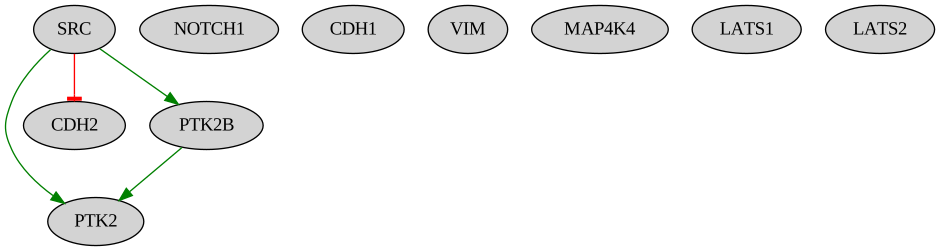
2C. Visualize the network with the following command.
The network picture is also exported in the working repository, in pdf format.
[7]:
visualizer = NetworkVisualizer(new_net1, color_by='effect')
visualizer.render()
2D. Connect disconnected nodes by importing intermediate nodes.
The parameter maxlen is used to verify that in the network all the nodes have a distance < than maxlen.
The parameter only_signed forces the algorithm to look for just signed interactions.
The parameter consensus retrieves those interactions with a sign consensus between the references.
The parameter connect_node_when_first_introduced, changes the base algorithm, making it look for possible connection between all the disconnected node in the network when a new bridge-gene is introduced in the network.
[8]:
%%time
new_net1.complete_connection(maxlen=6, k_mean="tight", only_signed=True, connect_node_when_first_introduced=True, consensus=False)
Found a path!
Found a path!
Found a path!
Found a path!
Found a path!
Found a path!
Found a path!
Found a path!
Found a path!
Found a path!
Found a path!
CPU times: user 3min 27s, sys: 98.8 ms, total: 3min 27s
Wall time: 3min 27s
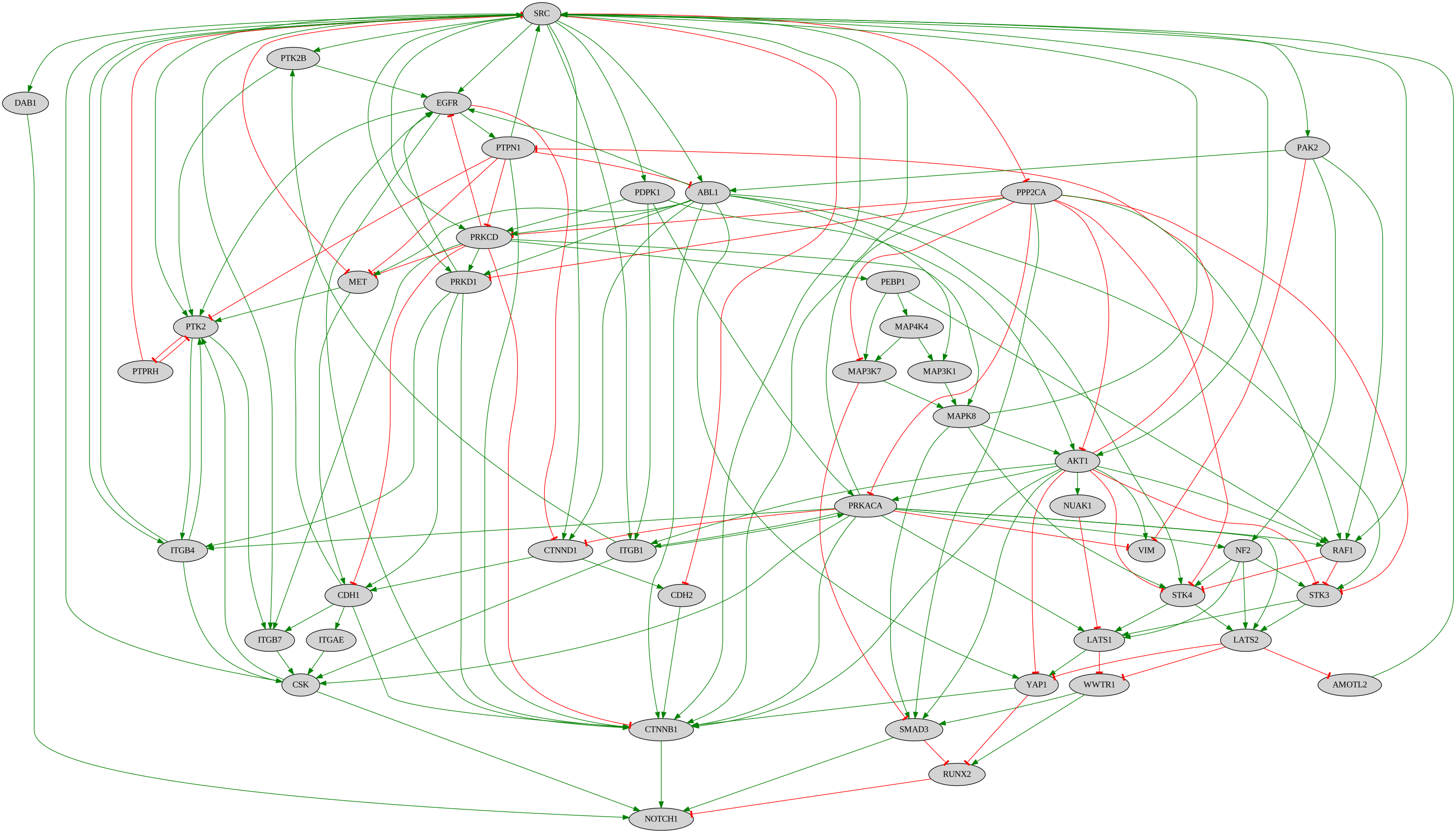
3. Visualize final network
[11]:
#Visualize a specific nodes and
visualizer1 = NetworkVisualizer(new_net1,color_by='effect')
visualizer1.render(output_file='network2')
[10]:
#Visualize a specific nodes and
visualizer1 = NetworkVisualizer(new_net1, predefined_node = "SRC",color_by='effect')
visualizer1.render(output_file='network2')

[10]:
#We can access to the edges of the network
new_net1.edges
[10]:
| source | target | Type | Effect | References | |
|---|---|---|---|---|---|
| 6821 | P12931 | Q05397 | None | stimulation | Adhesome:10085298;Adhesome:10592173;Adhesome:1... |
| 32968 | P12931 | P19022 | None | inhibition | ACSN:15782139;ACSN:16371504;ACSN:16492141;ACSN... |
| 5154 | P12931 | Q14289 | None | stimulation | Adhesome:10329689;Adhesome:10521452;Adhesome:1... |
| 44795 | Q14289 | Q05397 | None | stimulation | Adhesome:16760434;HPRD:16760434;KEA:12960434;K... |
| 11582 | P12931 | P35222 | None | stimulation | ACSN:10593980;ACSN:12123611;ACSN:15782139;ACSN... |
| ... | ... | ... | ... | ... | ... |
| 67482 | P00533 | Q05397 | None | stimulation | ACSN:10545505;ACSN:16919435;ACSN:17496910;ACSN... |
| 7631 | Q14289 | P00533 | None | stimulation | CA1:11274221;HPRD:10777553;InnateDB:14963038;S... |
| 73973 | P00533 | P35222 | None | stimulation | ACSN:12040186;ACSN:14585353;ACSN:17496910;ACSN... |
| 2907 | Q15139 | P00533 | None | stimulation | CancerCellMap:10523301;CancerCellMap:2984676;C... |
| 78053 | P00533 | P56945 | None | inhibition | KEA:17570479;ProtMapper:15951569;SPIKE_LC:1714... |
71 rows × 5 columns